


7 Common Mistakes in Warehouse Racking Design and How to Fix Them


Designing a warehouse racking system is one of the most critical steps that determines the overall operational performance of a facility. A properly engineered system helps maximize space, speed up loading/unloading, reduce accidents, and minimize long-term costs. However, in reality, many businesses make serious warehouse racking mistakes during the design stage. Understanding these common mistakes in warehouse racking design is essential, as they lead to wasted time, unnecessary expenses, and severe safety risks.
In Vietnam, the manufacturing, logistics, and warehousing sectors are expanding rapidly, yet the understanding of technical racking design has not kept pace. This is why BHD – Palletrack.vn frequently encounters improperly designed pallet racking systems: beams bending, racks shaking, poorly planned aisles, and even high risks of collapse. These mistakes—often referred to as racking design failures—are completely avoidable when businesses have proper knowledge from the start.
This article summarizes the 7 most common racking design mistakes that BHD – Palletrack.vn encounters during real-world projects, along with detailed solutions and a practical checklist to help businesses assess their current warehouse systems.
1. Incorrect Load Capacity Calculation – The Most Critical Design Mistake
One of the most common and most dangerous mistakes in warehouse racking design is miscalculating the load capacity. This error poses significant risks because it directly affects the stability, durability, and overall safety compliance of the entire system.
Many businesses calculate beam capacity based only on the weight of a standard pallet, while overlooking several essential factors, such as:
- Seasonal or project-based load increase
- Actual load density on each level
- Real pallet dimensions (1100×1100, 1200×1000, etc.)
- Uneven load distribution
- Floor load-bearing capacity
When the actual load exceeds the designed capacity, the rack is likely to bend, weld joints may crack, and beams can twist. This is one of the most frequent pallet racking design failures that Palletrack.vn experts consistently warn businesses about.
This miscalculation stands as the most critical of all warehouse racking mistakes because its failure mode is catastrophic, threatening both personnel and inventory. Avoiding this severe common mistakes in warehouse racking design requires moving beyond simple pallet weight assumptions.
Professional design must incorporate all variables, ensuring that the structural integrity of the racking system exceeds the maximum potential load under all operating conditions, thereby guaranteeing long-term safety and operational stability.
2. Choosing the wrong type of racking leads to design errors
Another frequent warehouse design mistake is selecting a racking system that does not match operational needs. Many businesses try to cut costs by choosing selective racks for every type of product, even when their warehouse includes:
- Heavy bagged goods
- Slippery pallets that tend to shift
- Products requiring FIFO rotation
- Items better suited for Drive-in systems
When the rack type is not appropriate, overall efficiency drops significantly, leading to common racking system failures such as:
- Poor forklift accessibility
- Increased handling time
- Higher collision rates
- Unstable product storage
To avoid early-stage pallet racking design errors, businesses must fully understand their operational requirements—inventory turnover rate, warehouse height, product characteristics, and the type of forklifts used.
Choosing an unsuitable rack type is a costly and recurring example of warehouse racking mistakes. This poor match between infrastructure and operational demand demonstrates one of the key common mistakes in warehouse racking design: prioritizing low initial cost over functional suitability.
Correcting this requires expert consultation during the planning stage, ensuring the chosen system—be it Selective, Drive-In, or specialized flow racks—perfectly aligns with present and future inventory flow, thereby avoiding disruptive and expensive mid-operation modifications.

3. Inefficient Floor Layout – A Major Cause of Space Waste
Many warehouses in Vietnam face the issue of “large floor area but limited usable storage space” because the layout is not scientifically planned. This is one of the most common pallet racking design mistakes that Palletrack.vn encounters, especially in factories that install racks on their own without a complete technical layout drawing.
Common layout errors include:
- Aisle width not aligned with forklift requirements
- Racks are placed too close to entry points, causing traffic congestion
- Overlooking ventilation fans, building columns, and electrical routes
- Beam levels set higher than the forklift’s maximum lifting height
- No dedicated staging or cross-docking area
These problems lead to a chain of racking system inefficiencies and can reduce warehouse productivity by up to 40%. When the floor layout is incorrect from the beginning, businesses will face high costs to reconfigure rack positions or expand aisles. Each adjustment disrupts operations and increases the risk of additional errors.
Unscientific planning is among the most damaging warehouse racking mistakes, turning large spaces into limited storage capacity due to inefficiency. This array of common mistakes in warehouse racking design—from incorrect aisle sizing to ignoring structural obstacles—cripples traffic flow and utilization.
The remedy is proactive, professional design that integrates all operational factors from the outset, ensuring the layout maximizes storage density, maintains smooth traffic, and permanently avoids costly, disruptive reconfigurations.
4. Incorrect Pallet Size Calculation – A Common Pallet Racking Design Error
Pallet dimensions directly affect:
- Beam spacing
- Clearance between rack rows
- Rack level height
- Load distribution on each beam
- Stability during forklift handling
Using old wooden pallets or pallets with inconsistent dimensions often breaks the original design parameters, leading to common pallet racking design issues such as:
- Pallets extending beyond the beam
- Pallets slipping between two beams
- Leaning loads that can easily fall
- Localized overloading at specific points
This is one of the most overlooked racking design mistakes, yet it poses significant operational risks. When pallets are uneven or damaged, the entire rack configuration can become unstable, especially during forklift operations. This misalignment causes beams to receive loads at incorrect positions, increasing the risk of bending, distortion, or overload.
Ignoring pallet quality is a dangerous example of warehouse racking mistakes that compromises the stability of even the best-engineered system. While often overlooked, this specific failure is one of the most critical common mistakes in warehouse racking design, as structural failure often begins with damaged or non-standardized support elements.
Mitigation requires strict material inspection and adherence to standardized pallet dimensions, ensuring the designed rack capacity and safety factors are consistently maintained during daily operations.

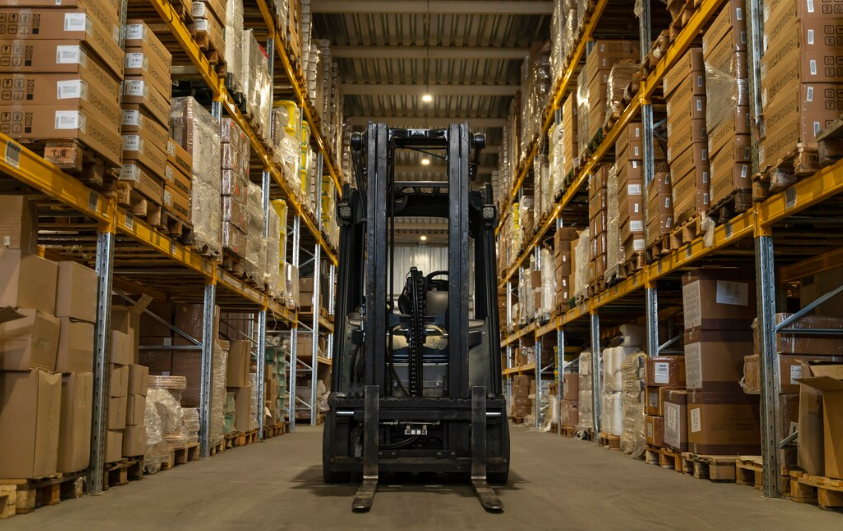
5. Failure to Calculate Forklift Interaction (Forklift Clearance Errors)
The interaction between forklifts and racking systems plays a critical role in warehouse safety and operational efficiency. However, many warehouses fail to calculate essential parameters such as:
- Forklift turning radius
- Fork reach distance
- Maximum lifting height
- Operator visibility during handling
- Safety clearance between racks and forklifts
These omissions lead to several common racking system issues, including:
- Frequent collisions between forklifts and racks
- Rack vibration when forklifts enter or exit aisles
- Inability to access pallets on upper levels
If not corrected promptly, this can become a serious pallet racking design flaw that compromises the entire system. To avoid this, businesses must ensure close coordination between the racking design team and forklift operators from the layout planning stage.
Ignoring operational reality is a foundational error among warehouse racking mistakes. This lack of holistic planning represents a critical common mistakes in warehouse racking design because it treats the rack system in isolation, disconnected from daily traffic and equipment realities.
The solution lies in integrating precise operational parameters—such as forklift turn radius and maximum lift height—into the initial design, thereby eliminating the root cause of collisions and ensuring that the final infrastructure is functionally safe and fully accessible.
6. Failure to Account for Floor Specifications, Anchor Bolts, and Safety Factors
This is the most technically critical mistake in pallet racking design.
If the warehouse floor does not meet engineering standards:
- Insufficient flatness (floor levelness out of tolerance)
- Insufficient thickness (sub-standard slab depth)
- Inadequate load-bearing capacity (low floor load rating)
In addition to the concrete slab, anchor bolts are a mandatory structural component. However, many facilities overlook them or install them improperly, leading to a series of racking system integrity failures, such as:
- Upright frames are becoming misaligned or leaning
- Beams vibrating or experiencing excessive deflection
- Entire rack aisles are collapsing under minor forklift impact
This is precisely a pallet rack design flaw originating from the installation and commissioning phase. To prevent these risks, businesses must ensure the warehouse floor meets engineering specifications and that anchor bolts are installed following the correct torque, embedment depth, and anchoring standards.
At the same time, routine rack inspection and maintenance are crucial to detect early warning signs such as frame sway, loose anchors, or beam deformation, thereby increasing system durability and overall operational safety.
Structural failures stemming from poor anchoring are catastrophic warehouse racking mistakes. Ignoring these mandatory installation standards represents a fundamental common mistakes in warehouse racking design, transforming simple vibration or minor impact into massive collapse risks.
Adherence to strict engineering torque and embedment specifications is non-negotiable, acting as the final line of defense to ensure the rack system maintains its intended stability and structural integrity against daily operational stresses.
7. Failure to Anticipate Future Expansion – A Strategic Mistake in Racking Design
Warehouses evolve due to:
- Increased throughput
- Changes in product SKUs
- Upgraded forklifts
- Compliance with export standards
- Optimization of logistics flow
However, many racking systems are not adaptable, as the initial design lacks flexibility. This is a common strategic error in pallet rack design among small to medium enterprises, resulting in:
- Complete dismantling of existing racks
- Inability to add additional rack levels
- Incompatibility with new standard pallets
- Inability to install mezzanine floors
Ignoring future adaptability is one of the most detrimental strategic warehouse racking mistakes. This critical omission represents a failure in foresight—a core element of common mistakes in warehouse racking design—that results in the entire system becoming obsolete as soon as operational needs change.
To future-proof the investment, designers must utilize modular systems and adaptable components, ensuring the infrastructure can seamlessly accommodate new throughput, different pallet types, or vertical expansion without requiring expensive and disruptive full dismantling.
8. The Role of BHD – Palletrack.vn in Reducing Racking Design Errors
With over 15 years of experience providing industrial racking solutions, BHD – Palletrack.vn specializes in designing, manufacturing, and installing racking systems that meet export standards.
Through collaboration with hundreds of logistics warehouses, cold storage facilities, dry warehouses, and production warehouses, BHD has observed that common racking design errors typically stem from:
- Absence of a comprehensive layout plan
- Lack of on-site survey
- Failure to adhere to load-bearing standards
- Selecting racks based solely on low cost
- Ignoring forklift interaction
These observations confirm that the most critical warehouse racking mistakes arise from fundamental planning and execution gaps. Recognizing these core sources of failure is key to avoiding common mistakes in warehouse racking design.
BHD – Palletrack.vn leverages this field experience to provide end-to-end solutions, guaranteeing that every installation is scientifically planned, structurally sound, and fully compliant with operational requirements, thereby maximizing long-term safety and ROI.
9. Checklist & Solutions to Minimize Warehouse Racking Design Errors
12 – Step Warehouse Rack System Evaluation Checklist
| Inspection Item | Key Question | Warning Signs | Proposed Solution |
| 1. Load Capacity | Is the design load equal to the actual load? | Beam deflection > L/200 | Reassess load capacity, replace the beam if needed |
| 2. Pallets | Are pallet sizes uniform? | Pallets slipping or protruding | Standardize pallet sizes across the warehouse |
| 3. Forklift | Is a forklift suitable for the rack? | Frequent collisions | Optimize aisle layout, install rack protectors |
| 4. Aisle Width | Are aisles wide enough? | Congested flow | Adjust warehouse layout |
| 5. Rack Anchors | Are anchor bolts properly secured? | Tilted columns | Retighten anchor bolts |
| 6. Warehouse Floor | Is the floor flat and strong? | Rack leaning | Repair or reinforce the floor locally |
| 7. Beam Tiers | Are tier heights appropriate? | Cannot lift a pallet | Adjust beam heights |
| 8. Safety Factor | Is extra load capacity considered? | Rack vibration | Increase material thickness or strength |
| 9. Number of Tiers | Are the tiers compatible with forklift reach? | Cannot access pallets | Lower tiers or upgrade forklift |
| 10. Emergency Exits | Are exit paths clear? | Blocked exits | Relocate racks to ensure clearance |
| 11. Internal Traffic | Are walkways provided for pedestrians? | Safety hazards | Install guardrails |
| 12. Scalability | Is the system easily expandable? | Cannot expand | Redesign the modular system |
Technical Solutions from BHD – Palletrack.vn
Rack design based on actual load reports
Each racking system is calculated according to the weight, dimensions, and handling frequency of goods, ensuring absolute safety and maximizing storage capacity. This solution aligns with modern warehousing trends, where space optimization and operational efficiency are top priorities.
Accurate load data prevents the worst warehouse racking mistakes. This design approach ensures structural integrity, directly solving the load miscalculation problem—the primary common mistakes in warehouse racking design—and guaranteeing safe, efficient, and compliant operations.
Application of 3D modelling & FEA (Finite Element Analysis) for deformation inspection
BHD employs 3D simulation and FEA (Finite Element Analysis) to assess deflection, vibration, and load-bearing capacity, ensuring that rack designs operate stably under real-world conditions. This advanced analytical process is the definitive answer to preventing catastrophic warehouse racking mistakes related to structural failure.
By simulating real-world stresses, FEA eliminates the risks inherent in load miscalculation—a primary common mistakes in warehouse racking design—ensuring the final installation achieves guaranteed safety compliance and long-term structural integrity before construction even begins.
Forklift Consultation for Each Warehouse
The technical team evaluates aisle dimensions, ceiling height, and pallet types to select the appropriate forklift, facilitating smooth operations and minimizing collisions with racks. Integrating forklift specifications into the design process is essential for avoiding critical operational warehouse racking mistakes.
This proactive consultation directly addresses a major source of system failure—incompatibility between equipment and infrastructure—which is a frequently overlooked element in common mistakes in warehouse racking design. By ensuring the forklift’s operational envelope matches the rack layout, businesses guarantee efficient traffic flow, maximize accessibility, and drastically reduce the risk of structural impact damage.
ISO-Compliant Installation with Chemical Anchor Bolts
The installation process adheres to ISO 9001 standards, utilizing chemical anchor bolts for secure fastening, enhancing the stability and lifespan of the racking system. ISO-compliant installation with chemical anchors directly prevents structural instability, which is a major source of warehouse racking mistakes.
This meticulous process eliminates the anchor-related common mistakes in warehouse racking design, ensuring maximum stability and long-term durability.
Periodic Inspection Every 6–12 Months
The racking system undergoes regular inspections for load capacity, deflection, and structural stability, ensuring continuous safety and early detection of potential structural risks.
Comprehensive Maintenance and Warranty
BHD provides periodic maintenance services and flexible warranty programs, allowing clients to operate warehouses without interruption while maintaining the system according to modern smart warehouse standards.

10. Conclusion
Designing the warehouse racking system is the most critical step to ensure efficient, safe, and cost-effective warehouse operations. However, a single mistake in racking design can result in:
- Damaged goods
- Reduced rack lifespan
- Congested material flow
- Increased risk of workplace accidents
BHD – Palletrack.vn recommends that enterprises conduct warehouse inspections using the checklist above to promptly identify racking system issues and fully address any pallet racking design errors before operating the entire system.
If you need a new design, retrofit, or inspection of your racking system, Palletrack.vn is always ready to provide professional support.
Contact BHD – Palletrack.vn for warehouse racking assessment today!


